

Featured WRI Experts:
National Readiness vs County Readiness for E-Mobility in Kenya

Riders swap batteries for their electric motorcycles at a charging station in Nairobi, Kenya. Photo by ARC Ride Crédit photo
ARC Ride
Key Takeaways
-
Kenya’s National Electric Mobility Policy aims to accelerate EV adoption, expand charging infrastructure and create green jobs. County governments will play a central role through land-use planning, permitting and investment facilitation. Sustained support is needed to strengthen county institutional, financial and technical capacity for effective implementation.
Urbanization and rising transport demand are putting real strain on Kenya’s transport system. Road transport already accounts for about 13% of the country’s greenhouse gas emissions, and this share is projected to rise to around 17% by 2030 as the population and economy grow. This trend has pushed transport to the center of Kenya’s climate commitments, with vehicle electrification identified as a priority intervention.
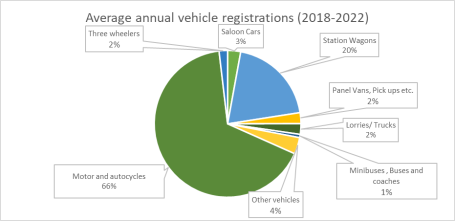
Source: WRI authors using data from Kenya National Bureau of Statistics 2023
Early in 2026, Kenya launched its National Electric Mobility Policy. At its core, the policy is not simply about putting more electric vehicles on the road. It is about reshaping the entire road transport ecosystem, from how vehicles are manufactured, imported and financed, to how roads construction and repairs are funded and how technical skills are built for this new industry.
It outlines how the country plans to move away from internal combustion engines to electric mobility by expanding charging infrastructure, supporting local assembly, strengthening safety and battery management standards and building the technical skills needed across the value chain. It also emphasizes inclusivity, ensuring that women, youth and low-income communities are not left behind.
Still, the transition will hinge counties, which are responsible for many of the practical elements including allocating resources, identifying land for charging infrastructure and developing local implementation plans. Their readiness will determine how quickly electric mobility takes root.
With a power grid already dominated by renewable energy, Kenya has a strong platform for cleaner transport, lower operating costs for everyday users and new opportunities in green jobs and manufacturing. According to the Global Energy Alliance for People and Planet (GEAPP), on average, Kenya’s motorcycle taxi drivers make around $10 a day, but spend nearly half of that on gasoline. Reducing that cost can double their daily take-home pay and lower maintenance costs. The big question now is whether national ambition and county-level action can move in step.
What the National Policy Envisions
The policy recognizes the early momentum. Annual EV registrations grew from just 0.022% in 2018 to 1.62% in 2023, driven by electric two-wheelers. Despite this growth, the policy also acknowledges there exists a gap between progress and ambition. Optimistic projections of registering 63,000 electric two-wheelers annually by 2027 still fall short of what national transition goals would require roughly 126% year-on-year growth. In other words, incremental change will not be enough.
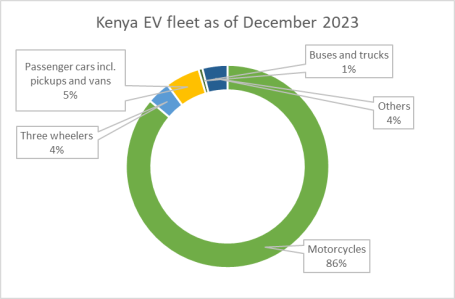
Kenya’s electric vehicle fleet composition 2023. Source: Kenya National Bureau of Statistics
Kenya’s electricity mix, about 80% renewable installed capacity, is positioned as a structural advantage. Electrification is not only feasible; it is aligned with the country’s broader climate and energy strategy. The policy therefore calls for accelerated uptake across all vehicle segments (two and three-wheelers, buses, freight and private vehicles) and deliberate expansion of charging infrastructure.
Historically, Kenya has stood out from its neighbors as a commerce-led economy, but the policy acknowledges that markets alone will not drive the EV transition. It establishes an integrated legal and regulatory framework to provide that structure. This includes finalizing standards for charging infrastructure and battery swapping systems, clarifying licensing and registration requirements, strengthening safety oversight and introducing environmental safeguards such as battery disposal standards and extended producer responsibility.
In parallel, the government signals that incentives will matter. The policy combines fiscal and non-fiscal measures across the value chain, from manufacturers and assemblers to charging infrastructure developers, with the aim of lowering costs and reducing risk. Such incentives range from the excise duty and VAT exemptions for EV parts, building off the Finance Act, 2023, to incentives for businesses and property owners to develop and install public EV charging infrastructure, establish EV manufacturing plants and export of locally built EVs and EV parts. The intent is not only to stimulate demand, but also to anchor local industry. Electrification is framed as an economic opportunity: a pathway to green jobs, industrial upgrading, and new technical capabilities.
Delivering that ambition, however, requires coordination. Implementation must cut across Ministries, Departments and Agencies and extend to Kenya’s 47 counties. An institutional implementation framework has been established, including the County Governments Act. Under Kenya’s devolved system, counties control land use planning, permitting, energy planning and key aspects of local infrastructure. In practice, this makes central actors determine whether charging networks expand, whether public transport electrifies and whether private investment flows.
The Electric Mobility Policy envisions a coordinated shift: clear rules, targeted incentives, grid readiness, local industry development, skills upgrading and fiscal reform. It reflects strong national intent. The critical question now is whether this national readiness can translate into county-level execution, where electrification will be delivered, or delayed.
The Readiness Gap: National Vision vs County Reality
Picture this: Kenya has signed transport sector commitments, passed legislation and attracted investors. Electric motorcycles are rolling off assembly lines, and the citys’ electric fleet is growing. Yet in most counties, there is minimal progress. Charging locations are sparse, nonexistent investment by the private sector, trained technicians are few and the matatu sector is yet to benefit from electrifications.
This is not a hypothetical failure. It is the shape that policy collapse takes in devolved systems, and it is entirely preventable if we are honest about where the real work of the e-mobility transition lives.
On paper, the architecture for a nationwide transition exists. At the county level, however, readiness is uneven. As of 2025, only two counties, Nairobi and Kisumu, had developed draft e-mobility policy frameworks. In addition, about 87% of EVs and 90% of charging infrastructure are estimated to be in Nairobi.
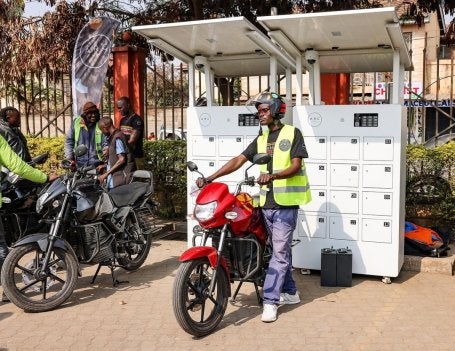
Riders swap batteries at an ARC Ride charging station. Image courtesy of ARC Ride
The policy assumes counties will operationalize key functions including spatial planning for charging infrastructure, local permitting, by-law development and enforcement. Without clear county-level bylaws, streamlined permitting processes or designated sites for charging infrastructure, private investors are bound to face inconsistent requirements and prolonged approval timelines.
On the other hand, unlike the national agencies e.g. the Ministry of Transport, Energy and Petroleum Regulatory Authority (EPRA), National Transport and Safety Authority (NTSA) and Kenya Bureau of Standards (KEBS), which have technical expertise and established regulatory mandates, county governments often lack dedicated e-mobility focal points. They also often lack specialized technical staff and integrated data systems. In addition, they report challenges spanning grid reliability, land allocation, financing constraints and unclear delegation of authority between national and county levels.
National ambition is real. But without stronger county-level policy frameworks, technical expertise and institutional anchoring, electrification risks remain uneven, advancing in a few urban centers, nascent elsewhere.
Why Counties Hold the Keys
Before a single EV can plug in, someone must decide where that charger goes. Is it on public land? Does it need a building permit? Is the land zoned for commercial activity? Is there a licensed operator to run it? Every one of those questions lands on a county government's desk. Counties are not passive recipients of a top-down transition. They control the physical spaces where electric mobility takes root. The matatu termini, bodaboda stages, city parking spots, etc. They issue the permits, allocate the land and license operators. They set up the local conditions that determine whether a national investment in EVs pays off or evaporates.
Infrastructure Readiness
Kenya's national grid planning is cautiously optimistic. The Kenya National Electrification Strategy is expanding coverage, and Kenya Power, the national electric utility, has begun conversations about EV charging infrastructure deployment. Nairobi is already pulling ahead. It has the commercial density to attract private investment, the institutional capacity to process permits and the grid connectivity to support fast-charging hubs. Serious EV ecosystems are beginning to take shape. The rest of the country has a different picture. In rural and peri-urban counties, charging sites haven't been identified, let alone built. Land for charging infrastructure has not been allocated in the county's spatial plans. The gap between urban and rural counties in infrastructure readiness is not a future risk. It is a present reality, and it is widening.
The uncomfortable truth is that Kenya's EV transition, if left to market forces alone, will electrify Nairobi and leave the rest of the country behind. That is not a transition. That is an existing inequality dressed in electric mobility.

A rider inspects an electric motorcycle in Nairobi, where electric two-wheelers are emerging as an important solution for reducing transport emissions and improving urban mobility in Kenya. Photo by Valentine Njoroge/ WRI
Financing and Investment
The national government is doing its part to attract EV investors through fiscal incentives, regulatory reforms and public-private dialogue at the national level. The pipeline of interest from manufacturers, charging infrastructure providers, and impact investors is real. But investment doesn't flow to interest alone. It flows to enabling environments. And at the county level, those environments are absent.
Most counties are still developing the policy and investment frameworks needed to support electric mobility infrastructure at scale. Clear revenue models for charging infrastructure remain limited, and few counties have explored public-private partnership (PPP) structures or targeted incentives such as streamlined permitting, reduced land lease costs, or tax relief to attract investment into charging hubs, repair facilities, and distribution networks. In practice, much of the current momentum has been driven by private sector actors operating despite regulatory and operational bottlenecks. As a result, investment continues to cluster in commercially attractive urban markets, while rural and peri-urban counties risk being left behind in the transition.
Fixing this requires counties to develop county-specific EV investment strategies: identifying priority charging sites, structuring PPP agreements and creating clear, published frameworks that tell investors exactly what they can expect.
Skills and Workforce
Kenya's transition needs people. Technicians who can install and service charging equipment, mechanics who understand EV drivetrains, and supervisors who can manage a depot and repair center safely and profitably. The Technical and Vocational Education Training Authority (TVET) and vocational training institutions should work on curriculum reforms to begin building this workforce. TVET institutions have county presence in the quality, capacity and gender-responsiveness of EV technical training. Many counties' TVETs do not have the trainers, equipment or updated curricula to produce EV technicians at a meaningful scale. Where training exists, it often defaults to assumptions: that the learner is male, the job is mechanical and that the role is individual rather than entrepreneurial. Women, who are increasingly active in the bodaboda economy and in charging station operations are poorly empowered because existing training is not designed with them in mind.
Urban counties with well-resourced TVETs will produce the first generation of EV technicians. Rural counties without updated equipment or qualified instructors will produce a workforce trained for an economy that is already changing around them. The county that integrates EV technical training into its TVET institutions now is not just preparing students for jobs. It is building the human infrastructure that makes the entire local transition possible.
Public Awareness
Kenya's national EV awareness story is growing. Media coverage is expanding. Government communication around EVs has increased. High-profile launches of electric motorcycles and buses and pilot projects have generated genuine public interest. But awareness campaigns launched in Nairobi do not necessarily reach other counties. And in the counties, the conversation about electric mobility is either nascent or absent.
Adoption is local. Where county leadership has publicly championed EVs, or where a local SACCO has piloted electric motorcycles, or where a private charging operator has set up shop near a stage, awareness, curiosity and adoption follow. Counties are the amplifiers of national intent. Without their active engagement through local awareness campaigns, community champions and visible county government adoption, the national signal remains noisy at the local level.
Coordination
The most important and least celebrated role of counties in the e-mobility transition is coordination. The utility needs to know where charging demand is growing so it can plan distribution upgrades. The national regulator needs to know which operators are licensed. The county transport planner looks at where the grid can support fast charging. The private investor is interested in where the county will prioritize land and permits. The TVET college needs to know which skills the local market requires.
None of these actors can make good decisions without information from others. And the county government is the only institution sitting at the intersection of all of them.
In a devolved governance system, the county is not a service delivery unit executing instructions from the national government. It is the connective tissue of implementation: the institution that makes coordination across sectors, actors and scales happen.
Without county-level coordination embedded in County Energy Plans, backed by data, and resourced with real capacity, the national e-mobility ecosystem will remain in a collection of isolated pilots and disconnected investments. Promising on paper; fragmented in practice.
A Question We Cannot Ignore
With Kenya's electric mobility story will ultimately be told not in the number of policies enacted nationally, but in the number of charging points that are actually operational locally: ones that work, that people trust, that generate local revenue, that are served by trained technicians, and that serve women as readily as men.
Every one of those outcomes has a county government somewhere in its causal chain.
National ambition is real. The technology is ready. The investment interest is growing. What remains uncertain is whether Kenya's 47 counties will be equipped, resourced, and motivated to do the work that only they can do.

