

Featured WRI Experts:
Advancing Transport Electrification in Ethiopia Amid Global Fuel Supply Disruptions
En savoir plus :
Cities

In Addis Ababa, public transport vehicles wait in a long queue for diesel at a fuel station in the Lideta area. Photo: Semere Jelalu/WRI Africa Crédit photo
Semere Jelalu/WRI Africa
Key Takeaways
-
Global fuel supply disruptions exposed Ethiopia’s vulnerability to imported fossil fuels, reinforcing the need to accelerate transport electrification. The country’s abundant renewable energy resources, ambitious e-mobility agenda and growing electric vehicle market offer a pathway to greater energy security, lower transport costs and a more resilient, sustainable transport system.
When fuel queues stretch for kilometers and commuters wait hours hoping public transport will eventually show up, the fragility of Ethiopia’s transport systems becomes impossible to ignore. A recent national fuel crisis — triggered by global supply disruptions after the conflict in Iran and the blockage of the Strait of Hormuz — has laid bare just how exposed the country is to external energy shocks. Yet the disruption has also created an unexpected opening: a moment to accelerate the shift toward electric mobility.
The crisis highlights a broader challenge facing many low- and middle-income countries (LMICs): dependence on imported fossil fuels leaves economies vulnerable to geopolitical events far beyond their borders. Across Africa, rising global oil prices have strained public budgets, increased transport costs and fueled social unrest. In Kenya, for example, recent fuel price hikes of more than 20% triggered nationwide transport strikes, leaving thousands of commuters stranded, disrupting businesses and schools, and contributing to deadly protests. The unrest illustrates how dependence on imported fossil fuels can quickly translate into economic disruption and public hardship.
Ethiopia faces similar structural vulnerabilities. The country’s transport sector is dominated by road transport, which depends on imported fuel. According to the National Bank of Ethiopia, the country's annual fuel import bill reached $3.6 billion in 2024 — representing 95% of the country’s foreign exchange earnings from merchandise exports and 20% of total goods imports.
However, Ethiopia recognized these risks long before the current fuel crisis. In a landmark move, Ethiopia became the first nation in the world to ban the importation and manufacturing of internal combustion engine (ICE) vehicles, seeking to accelerate the transition to e-mobility and capitalize on its largely renewable energy system, which is powered by approximately 90% hydropower. By reducing dependence on imported fuels and leveraging domestic energy resources, Ethiopia is positioning e-mobility not only as a climate solution, but also as a pathway to greater economic resilience, energy security and transport system stability.

A highway in Addis Ababa. Under its national e-mobility strategy, Ethiopia plans to expand charging infrastructure by building thousands of charging stations across cities and national highways. Photo: Gift Habeshaw/Unsplash
To manage the immediate impacts of the current fuel shortage, Ethiopia’s government has introduced emergency measures. Priority access to fuel has been given to fuel distributors, exporters, key industries, critical infrastructure and the transport of essential goods, alongside agriculture and public transport. Authorities have also urged citizens to reduce non-essential travel and rely more on walking and cycling where possible. While these measures may help alleviate short-term pressures, they are unlikely to fully address the underlying challenge: fuel demand continues to outpace supply, exposing the limits of a transport system that remains heavily dependent on imported fossil fuels.
A Systemic Approach to Transport Electrification
Ethiopia’s national five-year e-mobility strategy emphasizes the need for a transition towards sustainable transport and is a critical step towards a multi-level, systemic approach to transport electrification. It sets ambitious goals, such as increasing the share of electric vehicles (EVs) registered per year in the country from 40% to 80%; establishing 1,176 reliable charging centers in Addis Ababa, and 1,054 more across secondary cities and national highways; and ensuring that 30% of new EVs registered in the country are locally produced or assembled by 2030. There are already tangible impacts on the ground with EV importation rising from 7,000 per year in 2022 to 115,000 in 2025.
Despite these advances, Ethiopia remains vulnerable to external energy shocks. As a landlocked country that depends on neighboring countries’ ports and transport corridors for fuel imports, disruptions to global supply chains can quickly ripple through its economy and transport system. Yet Ethiopia also holds a distinct advantage: it is one of Africa’s largest producers of renewable electricity and exports surplus power to neighboring countries. Expanding electric mobility would allow Ethiopia to leverage this domestic energy resource, reducing its dependence on imported fuels while strengthening energy sovereignty. In doing so, the country can build a more resilient and sustainable transport system that is less exposed to global fuel price volatility and supply disruptions.
To reap the full benefits of electrification, the transition needs to take a systems-based approach that considers wider mobility challenges such as designing more compact cities and reducing the need for vehicle travel. Prioritizing public and mass transit systems offers Ethiopia the most efficient and equitable pathway toward electrification, as these modes concentrate large numbers of passengers along high‑demand corridors. Electrifying buses and other public transport alternatives reduces reliance on imported fuel at scale, delivering faster savings and cutting emissions more effectively than individual vehicles. At the same time, strengthening walking and cycling facilities complements the public transport system by ensuring safe and accessible connections to stations and stops, creating a seamless multi-modal network.

Tulu Dimtu Public Transport Station in Addis Ababa, Ethiopia, is part of a system that moves more than 2 million passengers per day, illustrating how high-demand public transit corridors offer the greatest opportunity for scalable electrification and reduced fuel dependence. Photo: Daniel Emale/Unsplash
The transition also requires a well-coordinated and institutionalized approach to implementation. A dedicated task force or steering committee that brings together key ministries such as transport, energy, finance and urban development will be essential to ensure alignment and accountability. In particular, reliable energy access and the rapid rollout of charging infrastructure are critical enablers; without them, electrification efforts will struggle to scale effectively.
At the same time, the financial and policy ecosystem must also reinforce the transition. Savings from reduced fuel imports can be strategically reinvested to support electrification and broader transport decarbonization efforts, including subsidizing charging infrastructure or offering lower off-peak electricity tariffs for public and commercial operators. Equally important is the continuous monitoring of electrification impacts, both at the macro and micro levels, to build political support and consumer confidence.
When embedded within a wider approach, electrification can drive systemic change. For example, optimizing and electrifying public transport routes provides cleaner and more sustainable transport options for the majority of residents — far more than implementing either measure in isolation.
A Golden Opportunity for Vehicle Retrofitting Efforts in Ethiopia
While Ethiopia’s policy commitments to electric mobility are commendable, addressing the large existing fleet of conventional vehicles presents an equally important challenge. To accelerate the transition, the government is exploring vehicle retrofitting as a key component of its e-mobility strategy, enabling ICE vehicles to be converted to electric power. This commitment is reflected in the recent inclusion of retrofitting kits on the country’s tax-exemption list, helping reduce costs and encourage adoption.
Yet building a new mobility system takes time. While Ethiopia invests in the long-term foundations of its e-mobility transition — charging infrastructure, public transport networks and supportive policy frameworks — thousands of minibuses, taxis and three-wheelers continue to operate every day, consuming imported fuel and joining ever-longer queues at filling stations. The challenge is not only how to build the transport system of the future, but also how to reduce dependence on imported fuel in the transport system that exists today.
This is where retrofitting becomes critical. Not as a silver bullet, but as a practical pathway for accelerating the transition. By converting existing vehicles to electric power, Ethiopia can begin reducing fuel demand, lowering operating costs and strengthening energy security without waiting for the entire vehicle fleet to be replaced. In this sense, retrofitting serves as a bridge between today’s transport realities and the cleaner, more resilient mobility system the country is working to create.
Retrofitting as a Technical and Policy Intervention
Retrofitting involves converting an ICE vehicle into an electric vehicle by replacing the engine, fuel system and related components with an electric motor, battery and control systems. For many vehicle classes, particularly high-utilization minibuses, taxis and three-wheelers, retrofitting can be faster and more affordable than purchasing new electric vehicles, especially in markets where EV supply remains limited. As a result, targeted retrofit programs can deliver near-term reductions in fuel consumption and imports while lowering operating costs for transport operators and improving urban air quality. These benefits can often be achieved at a lower upfront cost than large-scale new vehicle procurement programs.
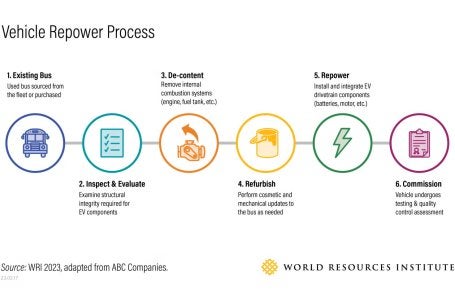
Recognizing this potential, Ethiopia has incorporated retrofitting into its five-year e-mobility strategy. The strategy identifies the development of retrofit standards and dedicated incentive packages as key priorities, while assigning responsibilities across government agencies, industry and research institutions. Planned measures include creating innovation-friendly regulatory frameworks, providing tax incentives and allocating land and other resources to support implementation. Together, these actions aim to establish a domestic retrofit ecosystem capable of accelerating electrification while supporting local economic development and job creation.
Despite its promise, retrofitting comes with various challenges. These include regulatory gaps, safety and homologation requirements, limited availability of standardized conversion kits, and a shortage of trained technicians and accredited conversion facilities. Cost is another major constraint, in some cases, retrofitting can be as expensive as purchasing a new vehicle, particularly for older models not compatible with modern technologies. If not done well, poorly executed conversions can also introduce serious safety risks, emphasizing the need for strong standards and regulations. Additional concerns include maintenance challenges, limited access to spare parts, and uncertainty around lifespan and resale value of retrofitted vehicles.
While successful pilot projects demonstrate the feasibility of retrofitting, scaling these efforts — particularly for larger vehicles used in mass transport — remains challenging. Doing so requires governments to go beyond pilot initiatives and establish conversion-specific technical legislation, certification and inspection regimes, and targeted investment in workforce training, research and development. Incentive structures must also be carefully designed to avoid unintended consequences and ensure quality standards are maintained as the market expands.
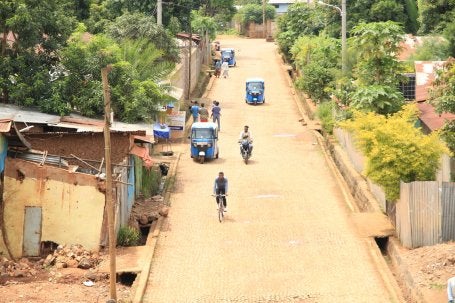
Cyclists, pedestrians and electric bajajs share a street in Jimma, Ethiopia. E-bajajs remain in pilot and early rollout stages, making up a very small share of the fleet. Photo: Ethiopian Human Rights Commission (EHRC)/Haleluya Abebe
Against this backdrop, Ethiopia’s exploration of retrofitting raises a critical set of considerations:
Structural bottlenecks
Introducing new solutions is often constrained by existing institutional and regulatory frameworks. Bureaucratic procedures can create unintended barriers that slow innovation and private sector entry. Addressing structural bottlenecks — particularly within tax systems, vehicle registration processes and import regulations — will be essential to unlock investment and ensure that current conditions are leveraged to accelerate, rather than hinder the transition.
Special incentives for the private sector
Ethiopia’s five-year e-mobility strategy outlines a range of incentives aimed at catalyzing private sector participation in the transition. Key measures include allocating workspace within industrial zones, improving access to finance, and creating a predictable and enabling regulatory environment. Together, these interventions are intended to reduce investment risk and encourage firms to engage in vehicle conversion, infrastructure development and related services.
Leveraging fuel savings
Retrofitting requires importing components that replace ICE systems with electric motors. Given that these investments generate long-term fuel savings, there is a strong case for establishing a dedicated financing mechanism that can support upfront conversion costs. In the context of current global fuel shortages and constrained import capacity, reallocating resources toward retrofitting components presents an opportunity to convert short-term disruptions into long-term system gains.
Tailored capacity building to enhance human capital
A large-scale e-mobility transition will require a skilled technical workforce. As retrofitting is still an emerging field, targeted training programs, certification pathways and technical capacity-building initiatives will be essential to equip technicians with the skills needed to ensure safe, standardized and high-quality conversions.
Focus on priority vehicle groups
Achieving economies of scale will be critical for attracting private investment and ensuring the viability of retrofitting initiatives. Prioritizing high-utilization vehicle segments — such as minibuses, meter taxis and three-wheelers that form the backbone of urban and secondary city transport systems — can help build sufficient demand to sustain retrofit markets. These vehicle types also offer the greatest immediate impact, as they account for high fuel consumption, emissions and daily travel distances.
Addressing constraints of the existing vehicle fleet
A key technical challenge that requires further examination is the condition of Ethiopia’s aging vehicle fleet. Detailed assessments and prototype testing are needed to evaluate whether older vehicles’ chassis can structurally support battery weight, as well as to address compatibility issues related to suspension, braking systems and spatial constraints for battery integration.
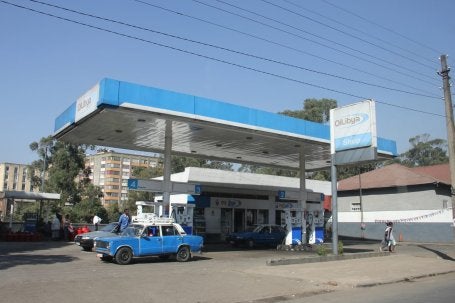
A Lada — a durable, boxy passenger car originally produced in Russia and still common in older transport fleets — gasses up at a fuel station in Addis Ababa. Photo: Hotel Kaesong/Flickr
Retrofitting efforts need further discussion and refinement, but the current energy crisis brings to the fore how volatile the transport system is. Supplying fuel to existing ICE vehicles will continue to be a major challenge for Ethiopia, even in the aftermath of the crisis.
This calls for a shift in focus — from narrowly prioritizing the importation of private electric vehicles toward more integrated, system-wide solutions. A resilient transport future will depend on strengthening public transport, while also prioritizing walking, cycling and more efficient land-use planning that reduces the need for long, costly and fuel-dependent journeys.
It is also important to acknowledge who bears the greatest cost when transport systems fail. It is not private vehicle owners who can absorb delays or shift their travel, but market traders, women navigating complex daily trips, students, and health workers relying on overcrowded minibuses in the early morning hours.
Ethiopia has already shown the world that bold decisions on e-mobility are possible. What this moment calls for is that same urgency applied to the vehicles already on the road — whether through retrofitting or other measures. With this approach, Ethiopia can turn a moment of crisis into an opportunity to build a transport system that is more sustainable, resilient, efficient and equitable for all.
Semere Jelalu is Urban Mobility Analyst for WRI Africa’s Thriving, Resilient Cities program.
Iman Abubaker is Cities Head in Ethiopia & Mobility Lead for WRI Africa’s Thriving Resilient Cities program.
Esthelyne Dusabe is Urban Mobility Project Specialist for WRI Africa’s Thriving, Resilient Cities program.
Amos Mwangi is Senior Electric Mobility Associate for WRI Africa’s Thriving, Resilient Cities program.
Valentine Njoroge is Communications and Engagement Specialist at WRI Africa.